Our series on operationalizing AI document workflows continues. This time: turning the materials and knowledge your team already has into repeatable AI workflows.

Regulatory and clinical teams are ready to use AI for document production. They already have the ingredients: templates that define structure, SOPs that describe process, source documents that contain data, guidance that reflects regulatory expectations. The challenge is turning all of that into something executable. Each piece exists — but they aren't connected in a way that an AI system can act on.
Most teams start with prompts — a chat interface, some instructions, a few examples. The results can look promising. But as soon as the goal is a structured, submission-ready document, the problem changes. Now the system needs to pull the right inputs, apply the right structure, generate sections in the correct order, and maintain consistency across the entire document. At that point, it's no longer a prompt — it's an agentic AI workflow. That's a fundamentally different undertaking, and building one requires technical resources most teams don't have.
This is the problem Blueprint AI Authoring is designed to solve.
From Materials to Blueprint
Teams describe what they want and upload what they have — templates, example reports, and supporting documents. From there, Everest's Blueprint Creator generates a complete agentic AI workflow automatically.
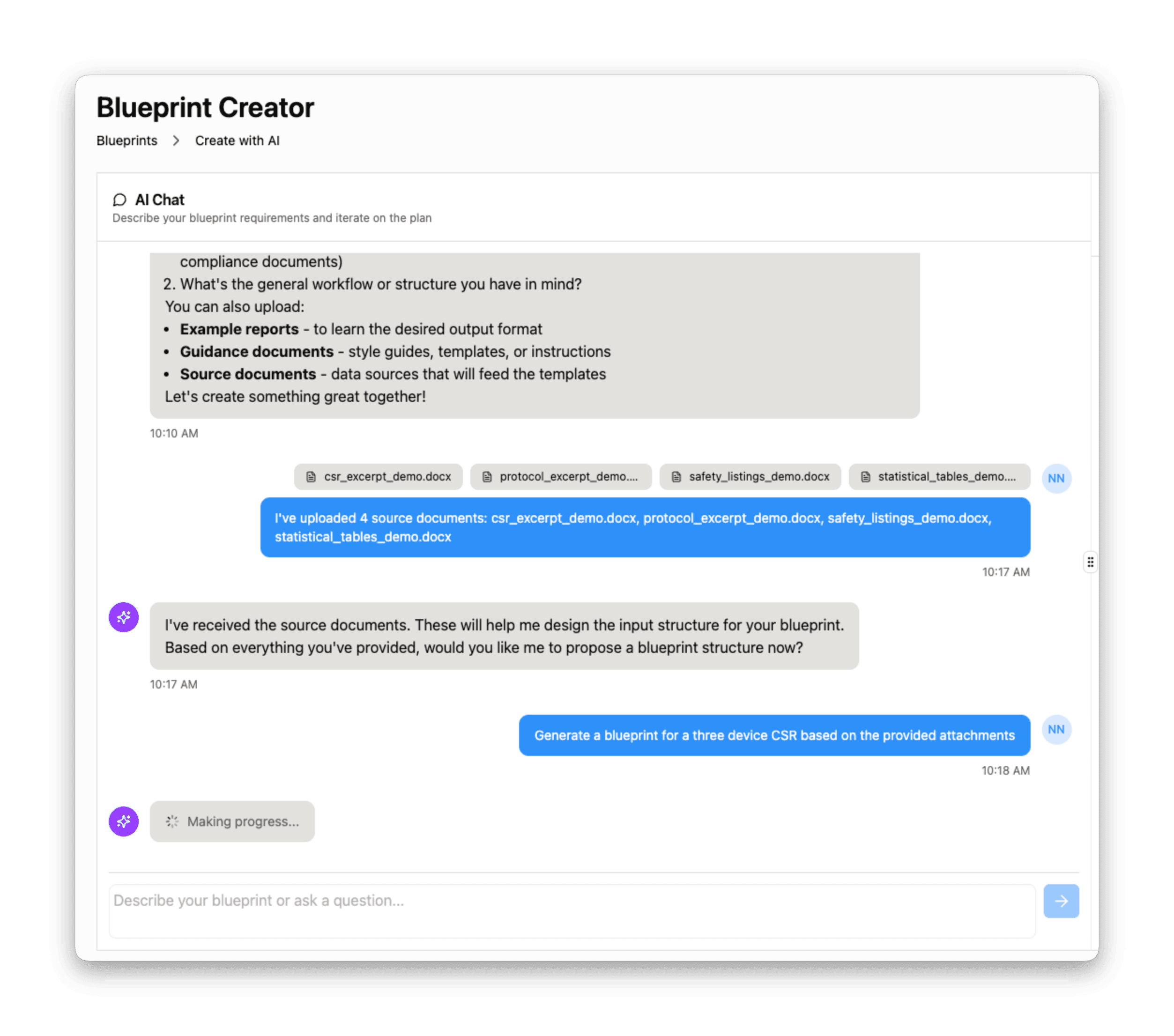
Teams upload their source documents and describe their goal in natural language. The Blueprint Creator takes it from there.
From the uploaded materials, the system infers document sections and structure, required inputs, dependencies between intermediate reports, and the sequence of steps needed to produce the final document.
The result is a Blueprint — a structured workflow that represents how the document should be produced.
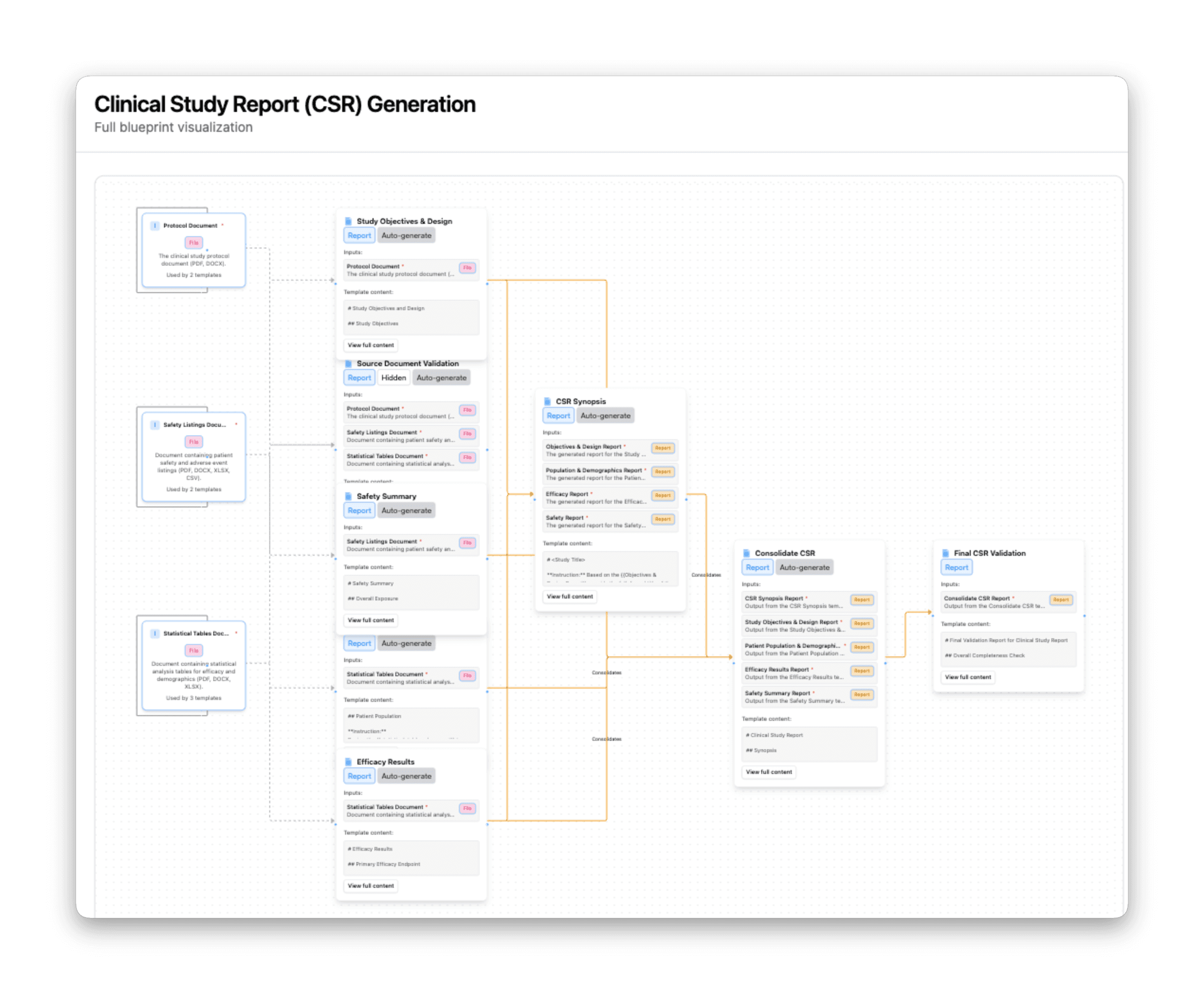
The generated Blueprint: a complete workflow showing how source documents flow through individual report sections, consolidation, and final validation.
The process happens in two stages. In the Plan phase, Everest proposes a workflow structure based on the uploaded materials. Authors can review the sections, inputs, and dependencies, and describe changes via chat to refine the plan before anything is generated.
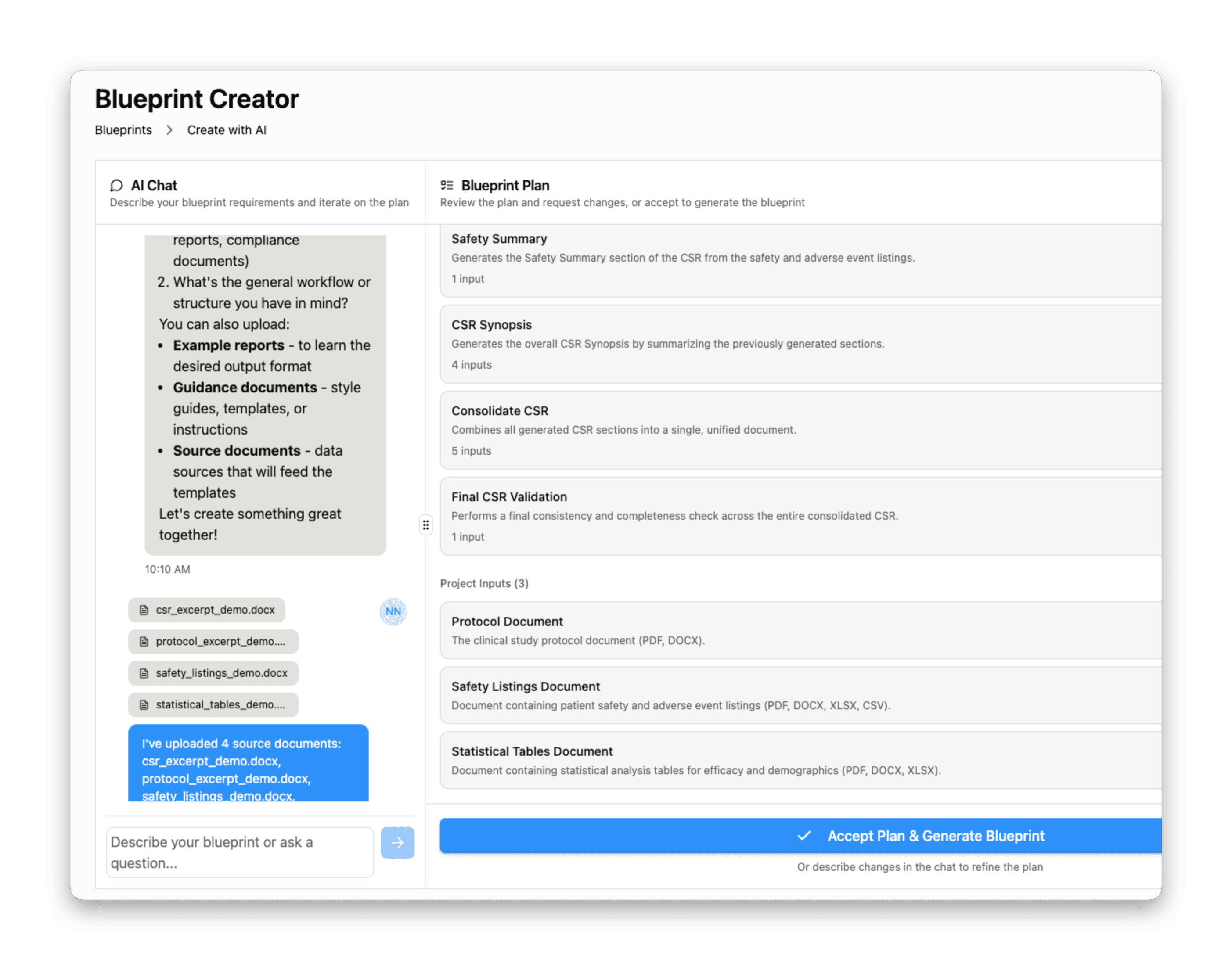
The Plan phase: Everest proposes a workflow structure — listing each section, its purpose, required inputs, and dependencies — for authors to review and refine.
Once the plan is right, the Execute phase generates the actual templates and blueprint configuration — producing a complete, runnable workflow.
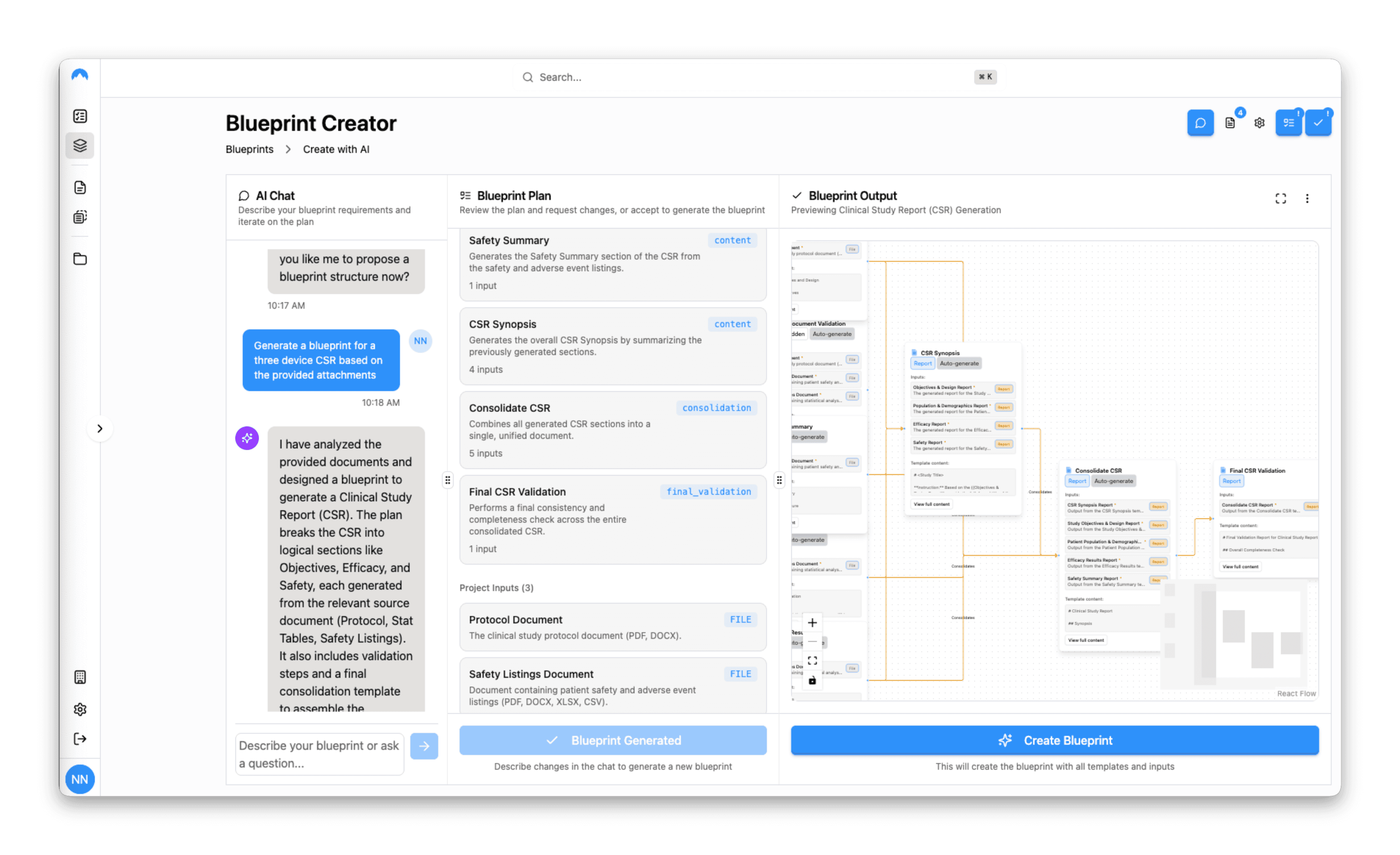
The Execute phase: the system generates the full blueprint, including templates and a visual workflow, ready for review and creation.
What previously required significant manual setup can now produce a working workflow in minutes. Teams can then refine that blueprint iteratively until it reflects their internal standards.
Over time, the organization's expertise becomes encoded in the workflow itself. Instead of relying on individuals to interpret templates and guidance, the system enforces the structure directly — creating reusable blueprints that any team member can run.
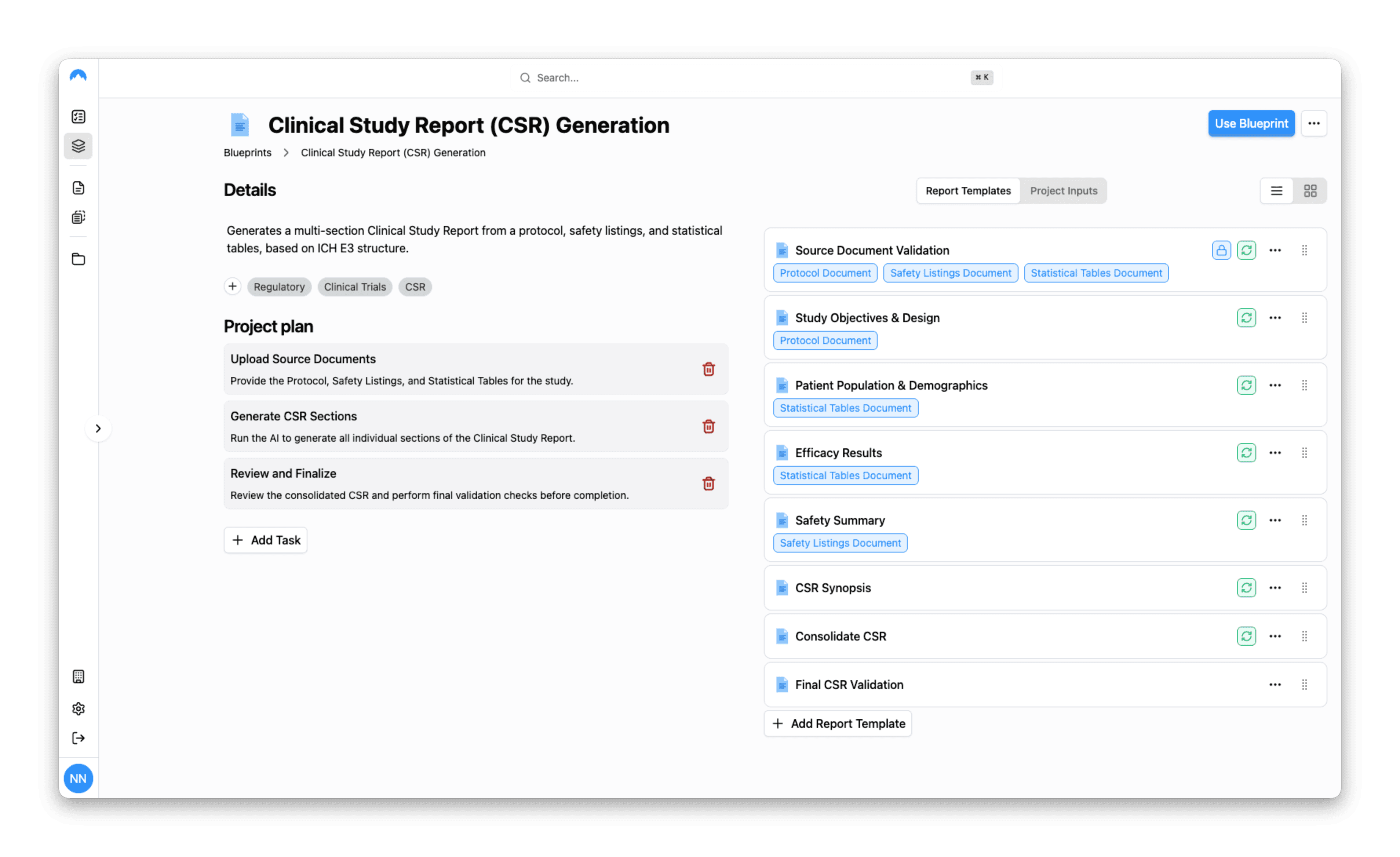
The finished Blueprint: a reusable workflow with report templates, project inputs, and a step-by-step project plan that any team member can run.
What used to live in the heads of senior staff — or scattered across templates, SOPs, and past submissions — now lives in something the system can run. Teams don't have to start from scratch each time, and they don't have to rely on the right person being available to interpret the process.
Templates capture what good looks like. Blueprints make it repeatable.
Next in the Series
Even the best workflows need to evolve. In 'Closing the Feedback Loop,' we look at how feedback from every document review can be turned into lasting improvements to the underlying workflow.
