New AI capabilities help teams move from existing source material to review-ready reports in minutes — while keeping humans firmly in control.
Today we’re launching a major upgrade to the Everest authoring experience. We believe workflow-driven AI authoring, while keeping humans firmly in control, will become the new standard for producing regulated and high-stakes documents.
If you’ve ever tried generating a regulatory document using AI, such as a clinical study report (CSR), eCTD submission module, clinical evaluation report (CER), or 510(k) submission, you know the truth: producing a basic first draft is relatively easy. The challenge is producing a first version that is specific to each program or product, structurally correct, grounded in the right source materials, and ready for expert review.
Each submission is different — whether a biologic or small-molecule IND, a device gaining a new indication, or an updated clinical dataset — and even small differences in inputs, requirements, or evidence can change how the document must be assembled.
That’s why we built Everest: to help regulatory, clinical, and quality teams, including CROs and consulting organizations, generate complex, high-stakes documents faster while keeping humans firmly in control.This release dramatically shortens time-to-value by helping teams move from existing source material to a review-ready report in minutes, not days.
The real problem: writing is iterative
Most AI writing tools are optimized for a single moment: you type a prompt, you get output. But real document work, especially in regulated environments, doesn’t happen in one shot.
Teams need to iterate. They need to refine tone, structure, and level of detail. They need peer review workflows. And they need to stay grounded in the same approved inputs and source materials, not recreate the document from scratch with a new prompt each time.
So instead of building “a chat bot that writes documents,” we focused on building something closer to what people actually do: a structured workflow for generating, refining, and approving complex reports.
This is what we believe will become the new standard for AI-assisted document authoring: systems that help teams operationalize entire document workflows, not just generate one-off drafts.
Three new AI capabilities
To support this workflow, we’re introducing three new AI capabilities for iterative document authoring: Blueprint Workflow Visualization, AI Template Builder, and Report AI Refinement. Together, these innovations transform existing document processes into repeatable, intelligent workflows, enabling teams to automate entire document pipelines, not just individual reports.
Blueprint Workflow Visualization: transparent workflows, not black boxes
As teams scale, they rarely generate just one report. They run repeatable workflows, a set of documents produced in sequence where each step depends on prior outputs. In regulated environments, teams must be able to see how reports are assembled, what inputs were used, and how intermediate steps connect, rather than relying on black-box generation that obscures how outputs are produced.
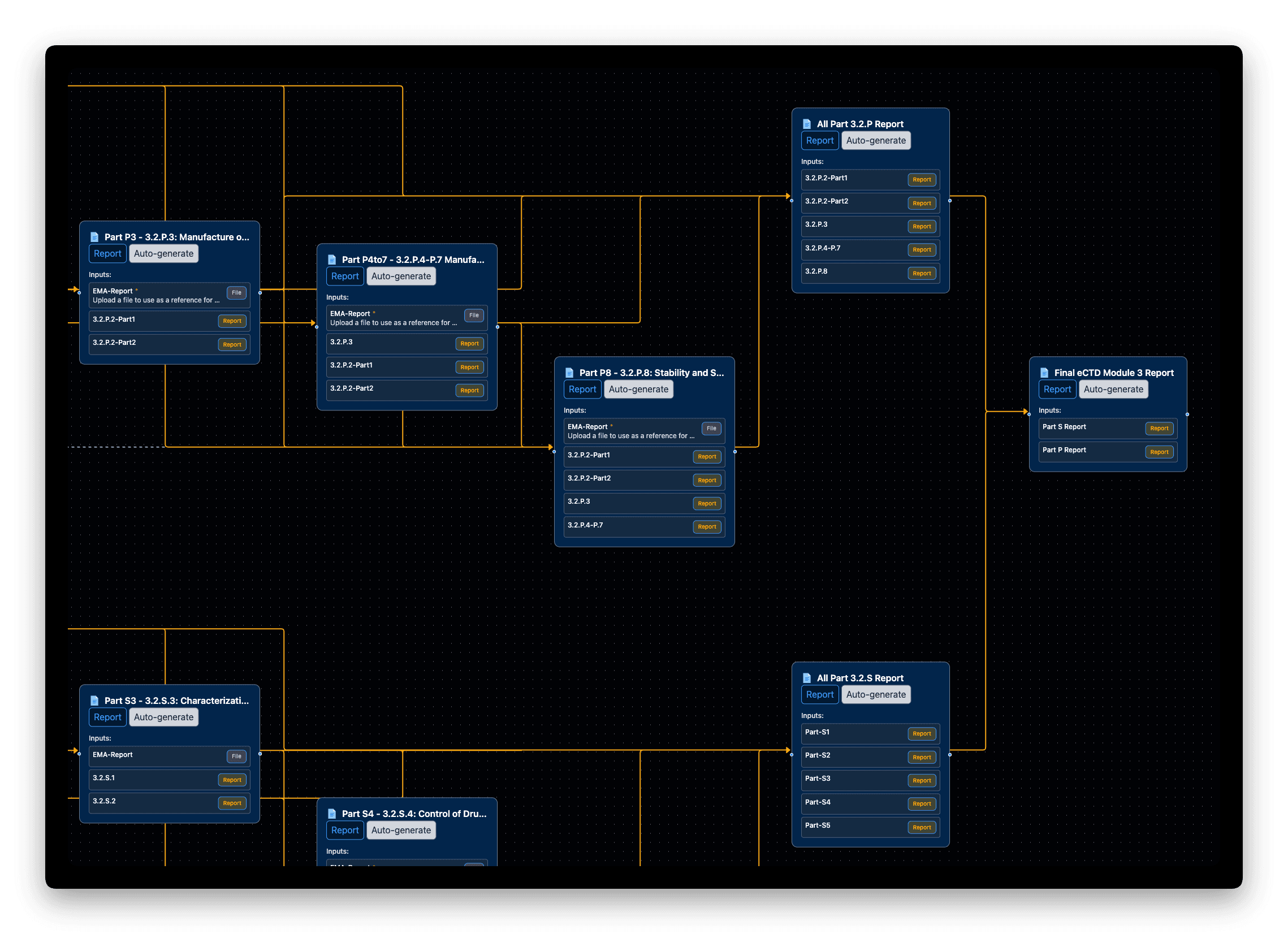
In Everest, we call these workflows Blueprints, structured processes that define the steps, inputs, and report templates needed to produce a complete package. With this release, we’ve added a visual workflow view that makes these pipelines easy to understand at a glance, giving teams clear visibility into how inputs flow through intermediate steps to final outputs.
Blueprint Workflow Visualization for an eCTD Module 3 report illustrating how intermediate reports, generation steps, and final submission outputs connect in a single transparent workflow.
Visual workflow representation showing tasks and dependencies, so complex workflows are transparent and auditable
Clear data-flow visibility from file inputs through intermediate generation steps to final outputs
Project‑level status tracking so teams can see what’s complete or pending review
This visibility is especially important for customers working with clinical trial data or other sensitive source material, where teams must maintain clear traceability across the full document pipeline.
AI Template Builder: smart templates, in minutes
Templates are the foundation of any scalable document workflow. In Everest, templates go beyond the static outlines teams typically use as starting points for their documents; they become smart templates that guide the AI, defining required inputs, applying decision logic, and controlling how each section of a report is generated.
But template authoring is also one of the biggest sources of friction, especially for teams adopting automation for the first time. It’s easy to overlook a required input, configure something incorrectly, or create a template that works for one report but fails on the next.
Our AI Template Builder makes it possible to move from existing materials to a working smart template in minutes. Instead of configuring everything from scratch, teams can start with their current static templates, example outputs, and supporting source documents, and Everest generates an initial executable smart template that follows established structures and best practices.
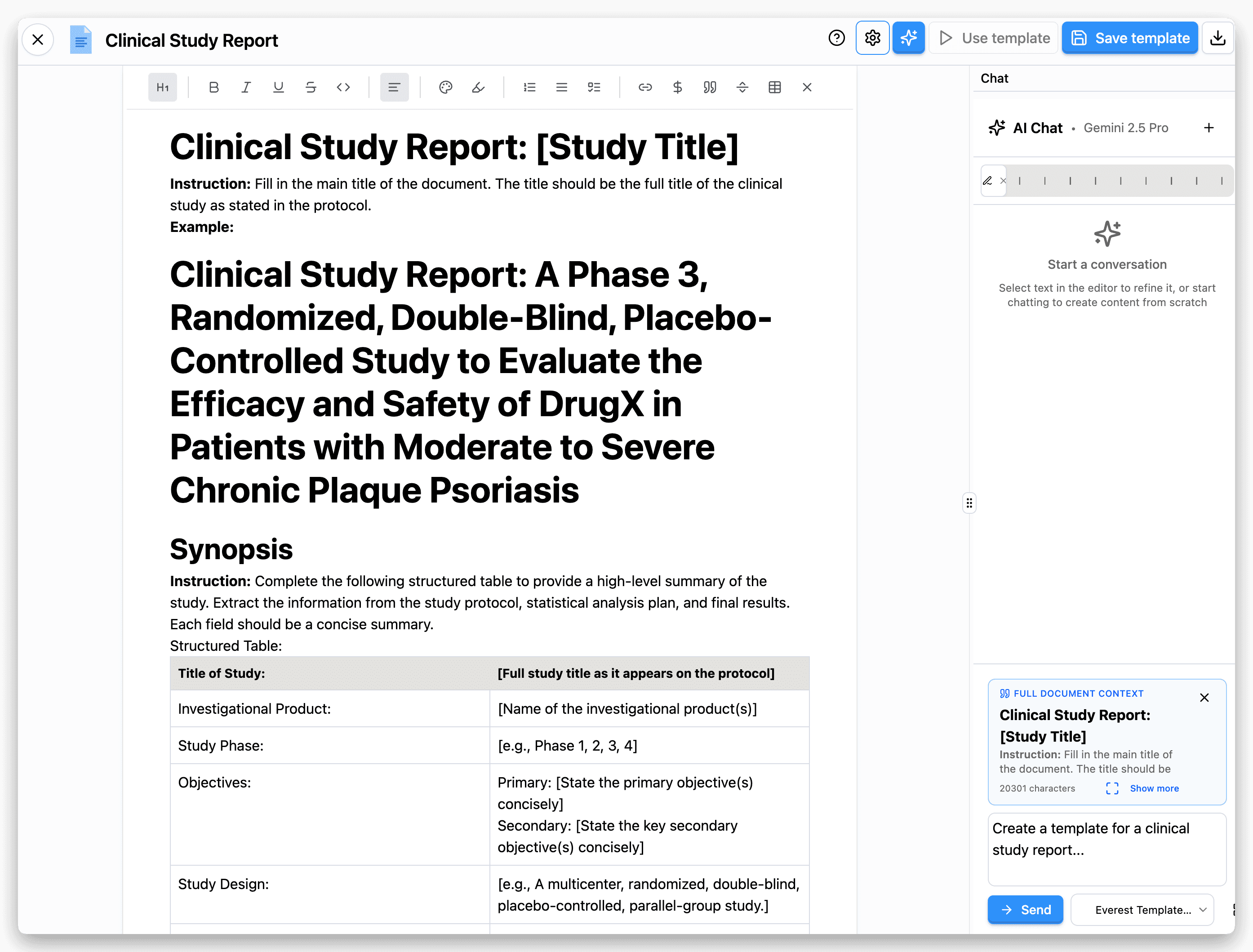
AI Template Builder generates smart, executable templates from existing materials — enabling teams to define inputs, configure logic, and iteratively refine sections through chat in a single collaborative workspace.
From there, teams can refine the template iteratively: select any section, adjust requirements or tone through chat, and incorporate feedback over time. Conversation history captures prior decisions, making it easy for teams to collaborate and maintain consistency as templates evolve.
Generate smart templates from existing materials — including templates, outputs, and source documents (DOCX, PDF, CSV)
Iteratively refine sections through chat, adjusting structure, tone, and requirements
Leverage conversation history so teams can incorporate prior feedback, improve templates over time, and maintain consistency
Incorporate external references using optional URL context and web search when public references or standardized language is required
The result is a dramatically shorter path from “we want to automate this report” to “we have a working template that reliably generates something reviewable.”
Report AI Refinement: editing that feels natural
Generating a first draft is only the beginning. In real workflows, the next steps, tightening language, expanding key sections, and aligning tone to internal standards, are where quality is refined and consistency is ensured. These adjustments often require multiple editing cycles, making revision one of the most time-consuming stages of document production.
Report AI Refinement is designed to accelerate this stage while keeping authors fully in control. Instead of rewriting sections manually or starting over with new prompts, teams can refine content directly within the document, applying targeted improvements that preserve structure, context, and prior decisions, and quickly polish drafts for review and approval.
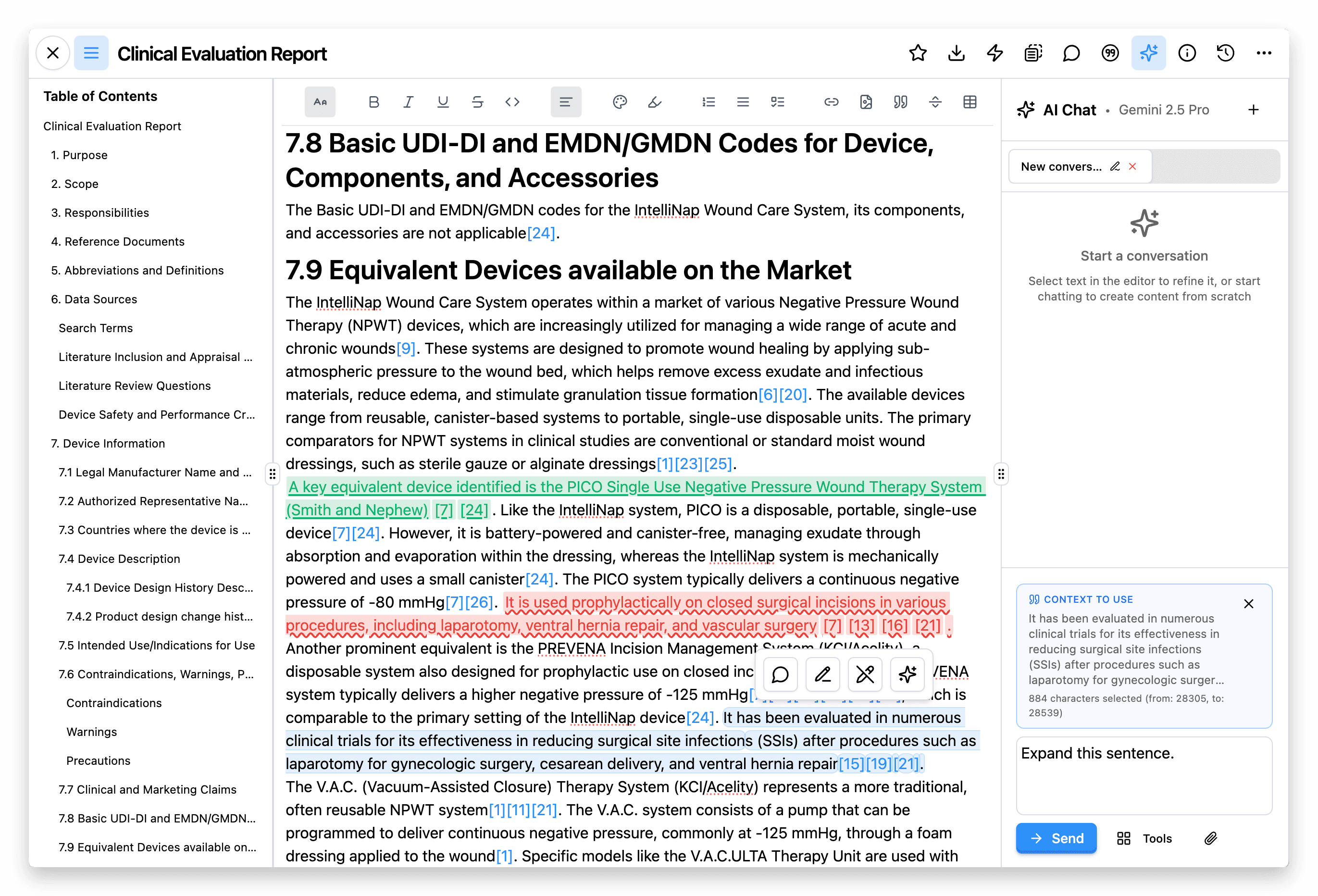
Refine report content directly within the document — generate suggested revisions with AI chat, review changes side-by-side, and maintain full author control.
Users can select any part of a report and apply common refinements instantly:
Rephrase a paragraph for clarity
Shorten or expand a section
Convert narrative text into bullet points
Adjust tone (more formal / more casual)
Summarize long sections for executive review
Enter custom instructions (e.g., translate text, apply internal standards, or format for specific requirements)
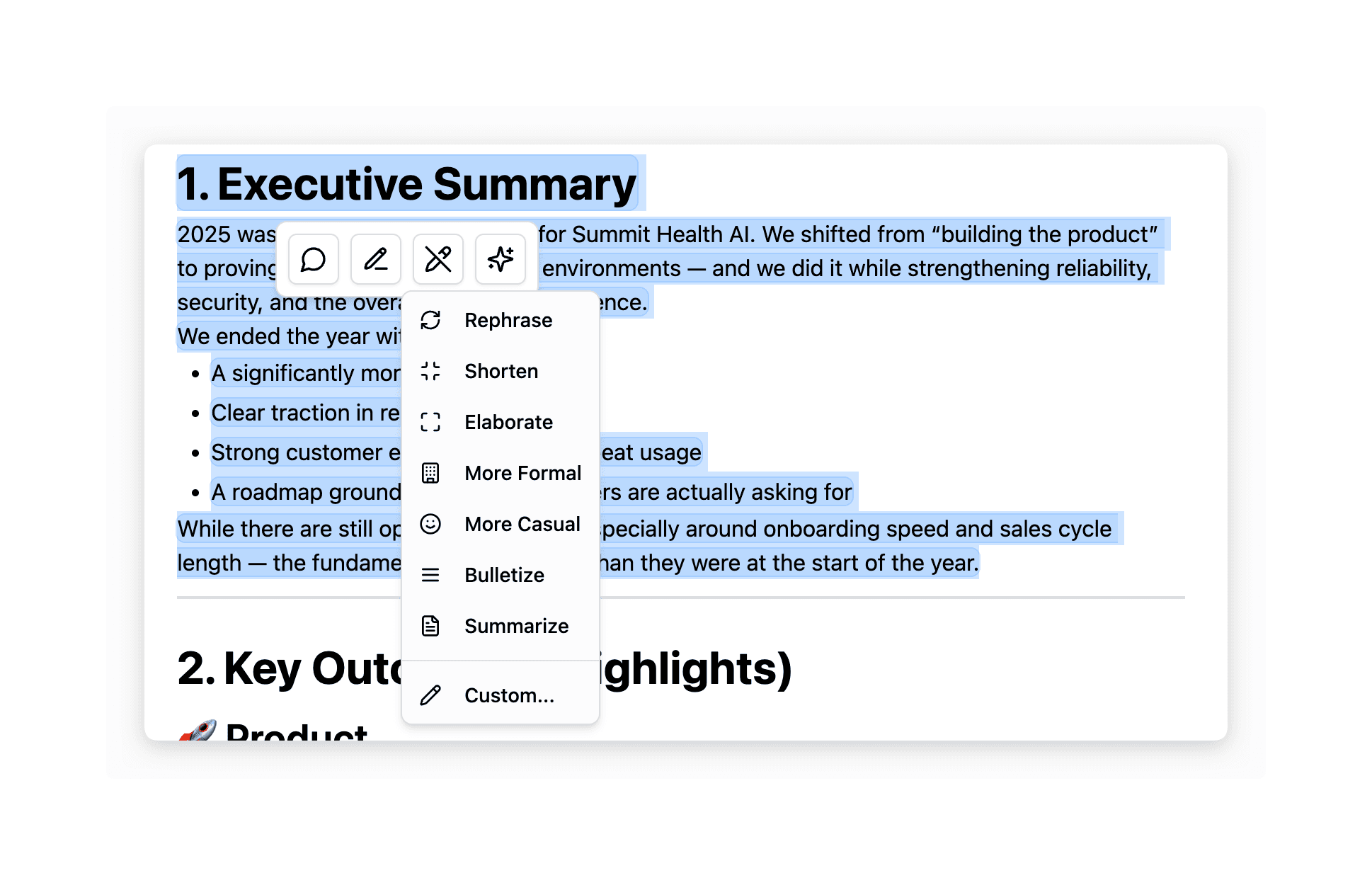
Apply instant, targeted refinements to any selected text — including rephrase, shorten, elaborate, tone adjustments, summaries, or custom AI instructions.
Just as importantly, refinements can be produced as suggestions, making it easy for teams to peer review changes without losing the original wording. Everest’s AI-powered refinement supports a controlled editing workflow where the human author remains fully responsible for what ships, while dramatically reducing the time required to move from draft to approval.
The new standard for AI-assisted document authoring
Document production is shifting from one-off drafting to repeatable, intelligent workflows that allow teams to move from source material to approved reports dramatically faster while keeping humans firmly in control. Organizations producing complex regulatory and clinical documents are now operationalizing workflow-driven AI to scale output without sacrificing rigor, traceability, or expert oversight.
With the Everest AI authoring experience, teams can:
Start from existing source materials and generate smart, executable templates with the AI Template Builder, embedding document structure, inputs, and workflow logic from the outset.
Generate high-quality first drafts in minutes and refine them interactively using Report AI Refinement (inline and chat), applying targeted improvements while preserving full author control.
Review and approve changes through suggestion-based workflows that maintain clear edit traceability and collaborative oversight.
Track the entire document-production pipeline through Blueprint Workflow Visualization, providing transparent visibility into workflow steps, dependencies, and outputs.
AI-assisted document workflows do not replace expert authors; they amplify their impact. By removing the slowest and most repetitive stages of document production, teams can focus their time on scientific judgment, regulatory strategy, and critical decision-making where expertise matters most.
See it live
If your team produces regulated or high-stakes documents, book a demo to see how Everest transforms your existing source materials into repeatable, review-ready workflows in minutes while keeping experts fully in control.
